


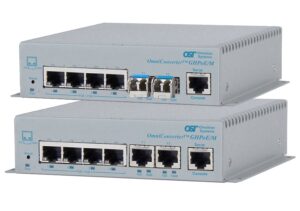
The OmniConverter GHPoEBT/M are compact managed Ethernet switch that features two 1/10G uplink ports and four 10/100/1000 RJ-45 IEEE 802.3bt 60W or 100W PoE user ports.
The OmniConverter PoE switches are standard Layer 2 Ethernet switches that forward frames to any port based on their MAC address.
All models support Directed Switch mode, which directs multicast traffic (such as video) only to the appropriate uplink port, preventing multicast traffic from flooding other network ports. Models with two fiber or two copper uplink ports support redundant uplinks, industrial ring Media Redundancy Protocol (MRP), Rapid Spanning Tree Protocol (RSTP) and daisy-chain configurations for high availability industrial network applications.
Models with two fiber or two copper uplink ports also support Dual Device mode that enables the switches to operate as two independent and isolated Ethernet switches.
The mode of operation can be configured using easily accessible DIP-switches or using Web, Telnet, SSH, SNMPv1/v2c/v3 or Serial Console management interfaces. IPv4 and IPv6 are supported on the switches. These management interfaces provide access to filtering and security options, such as, broadcast storm prevention, IGMP, IEEE 802.1x, RADIUS, TACACS+ and Access Control Lists. Email notification and alarm reporting is provided.
The OmniConverter PoE switches are available with fixed fiber ST, SC, and LC connectors or Small Form Pluggable (SFP) transceiver receptacles. Fiber ports support multimode or single-mode and dual fiber or single-fiber with distances up to 140km. SFP models support a variety of distances in standard, CWDM and DWDM wavelengths.
The switches feature a PoE Power Reset function that enables the user to remotely power-cycle and reset each PD, such as a camera or access point. They also feature a configurable Heartbeat Reset function that automatically pings the attached PDs and automatically power cycles and resets the PDs when detecting a heartbeat loss. The Power Reset and the Heartbeat Reset functions save time and expense by eliminating the need to dispatch manpower to remote network sites.
Features
- Managed 1G 60W and 100W PoE Ethernet Switch
- Supports the IEEE 802.3bt 60W or 100W
- Modbus Industrial Protocol for device management and monitoring
- Supports IPv4 and IPv6
- IEEE 802.1x, RADIUS, TACACS+ and ACL
- Email Notification
- Rapid and Multiple Spanning Tree Protocol
- Media Redundancy Protocol (MRP)
- IEEE 802.1ax LAG and LACP; Active/Active and Active/Standby
- IEEE 802.1Q VLAN tagging and IEEE 802.1ad Q-in-Q
- Broadcast / Multicast / Unicast Storm Prevention
- DHCP Relay Option 82, DHCPv6 and DHCPv6 Relay
- IPv4 IGMP and IPv6 MLD snooping
- Rate Limiting, Queue prioritization and Class of Service
- IEEE 802.1ab Link Layer Discovery Protocol
- Static MAC configuration and blocking of unknown Unicast/Multicast addresses
- PoE Watchdog Self-Healing function / PoE Heartbeat Monitoring and Configurable PoE Power Reset
- PoE power management with LLDP MED and MDI TLV, and PoE Power Multi-Day Scheduler
- Management via Web, Telnet, SSH, SNMPv1/v2c/v3 and serial interfaces
- Easy to use Hierarchical Command Line Interface
- SNMP management via Omnitron’s NetOutlook® management software, or third-party SNMP software
- Dual Device mode configured as two separate switches
- Directed Switch mode prevents flooding of multicast video traffic
- Free 24/7/365 Technical Support
ADDITIONAL FEATURES
- Two 10/100/1000 copper or 100M*/1G fiber uplink ports
- Four 10/100/1000 copper user ports
- ST, SC and LC fixed fiber ports or standard, CWDM or DWDM Gigabit SFP transceivers
- AC to DC Power Adapter or 2-Pin DC terminal
- Wall, Rack and DIN-rail mountable
- Fan-less design for long life
- Commercial (0º to 50ºC), wide (-40º to 60ºC) and extended (-40º to 75ºC) operating temperature ranges
- TAA, BAA and NDAA compliant, and Made in the USA
*100Mbps supported with 100M SGMII SFP Transceivers
| Description | OmniConverter® GHPoEBT/M (60/100W BT) 10/100/1000BASE-T with Gigabit Fiber or Copper Uplinks Managed 6 Port IEEE 802.3bt PoE Ethernet Switch | ||
|---|---|---|---|
| Standard Compliances | IEEE 802.3, IEEE 802.1Q, IEEE 802.1ad, IEEE 802.1ab, IEEE 802.1ax, IEEE 802.1w RSTP/MSTP, RFC 5424, RFC 4541, RFC 2710, IEC 624339-2, SMTP, SNTP, RADIUS, TACACS+, IEEE 802.1x, IEEE 802.3af (15.40 watts), IEEE 802.3at (30 watts), IEEE 802.3bt (60 and 100 watts max) | ||
| Regulatory Compliances | Safety: UL 62368-1, UL 60950-1, IEC 62368-1, IEC 60950-1, EN 62368-1, EN 60950-1, CAN/CSA C22.2 No. 62368-1-14, CAN/CSA C22.2 No. 60950-1, CE Mark, UKCA EMC: EN 55032/24 CE Emissions/Immunity, IEC 61000-6-4 Industrial Emissions, IEC 61000-6-2 Industrial Immunity EMI: CISPR 32, FCC 47 Part 15 Subpart B Class A EMS: IEC 61000-4-2 ESD: Contact: 6 kV; Air: 8 kV, IEC 61000-4-3 RS: 80 MHz to 1 GHz: 10 V/m, IEC 61000-4-4 EFT: Power: 2 kV; Signal: 1 kV (DC models), IEC 61000-4-4 EFT: Power: 1 kV; Signal: 1 kV (AC models), IEC 61000-4-5 Surge: Power: 2 kV; Signal: 2 kV (DC models), IEC 61000-4-5 Surge: Power: 1 kV Line/Line; 2 kV Line/Gnd; Signal: 2 kV (AC models), IEC 61000-4-6 CS: Signal: 10 V, IEC 61000-4-8 (Magnetic Field) 30A/m, IEC 61000-4-11 (Voltage Dips, interrupts) IP Rating: IP20 Protection ACT: TAA, BAA, NDAA | ||
| Environmental | REACH, RoHS and WEEE | ||
| PoE Modes | IEEE Alternate A (Alt A) 4-Pair | ||
| Management | IPv4 and IPv6 address Web, Telnet, SSH, SNMPv1/v2c/v3 In-Band management via Ethernet port Out-of-band management via serial port | ||
| Frame Size | Up to 10,240 bytes | ||
| Port Types | Copper: RJ-45: 10/100/1000BASE-T Fiber: Fixed: ST, SC, LC 1000BASE-X Fiber SFP: 10/100/1000BASE-T SGMII Copper Transceiver or 100BASE-X SGMII Fiber Transceiver or 1000BASE-X SERDES Fiber Transceivers Serial: RJ-45: RS-232 | ||
| Cable Types | Copper: EIA/TIA 568A/B, Cat 5 UTP and higher Fiber: Multimode: 50/125, 62.5/125µm Single-mode: 9/125µm Serial: Category 3 and higher | ||
| AC Power Requirements (Models with AC/DC Adapters) | 100 – 240VAC 50/60Hz 3.5A max at 115VAC 2.5A max at 230VAC | ||
| DC Power Requirements (Models with DC Terminals) | 60W Models: +46 to +57VDC; 4.46A @ 56VDC 2 Pin Terminal (isolated) | 100W Models: +46 to +57VDC; 7.31A @ 56VDC 2 Pin Terminal (isolated) | |
| Dimensions (W x D x H) | 6.28” x 5.2” x 1.5” (159.5 mm x 132.1 mm x 38.1 mm) | ||
| Weight | Module Only: 1.6 lbs.; 735 grams Module with AC/DC Adapter: 3.7 lbs.; 1703 grams | ||
| Operating Temperature (See Temperature Derating Table) | Commercial: 0 to 50°C Wide: -40 to 60°C (-20°C AC cold start) Extended: -40 to 75°C – not available for models with AC/DC Adapters Storage: -40 to 80°C | ||
| Humidity | 5% to 95% (non-condensing) | ||
| Altitude | -100m to 4,000m (operational) | ||
| MTBF (hrs) | Module Only: 266,000 AC/DC Adapter: 100,000 | ||
| Warranty | 5 year product warranty with 24/7/365 free Technical Support 2 year AC power adapter warranty | ||
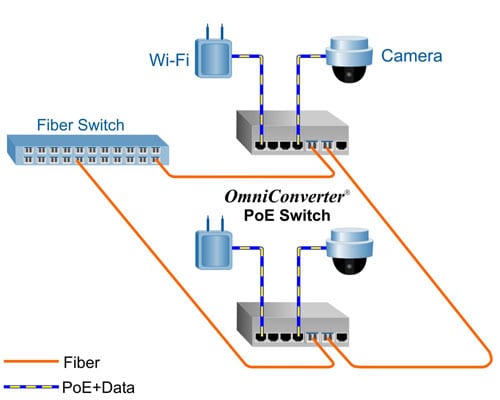
Daisy-Chain and Ring Topology Network Application
This example demonstrates the daisy chaining and ring capabilities of the OmniConverter. In this application each OmniConverter switch connects to its neighboring switches via its uplink ports eventually closing the ring.
Using this network architecture combined with ring protection protocols such as Media Redundancy Protocol (MRP) or Rapid Spanning Tree Protocol (RSTP) facilitates a highly resilient network required in mission critical applications.
Dual Device Mode Application
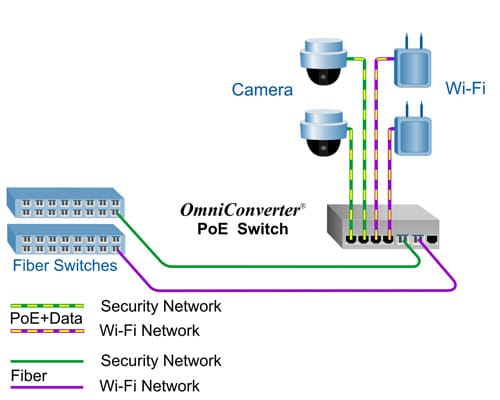
This Dual Device feature is extremely useful when two isolated networks domains share a single network distribution location.
The example below depicts a scenario where a surveillance security (green) network and a Wi-Fi (purple) network are sharing a single hub distribution location. Using the two uplinks and the Dual Switch mode facilitates using a single PoE switch driving both the Cameras and the Wi-Fi Access Points while maintaining isolation between the networks.
PoE Power Multi-Day Scheduler
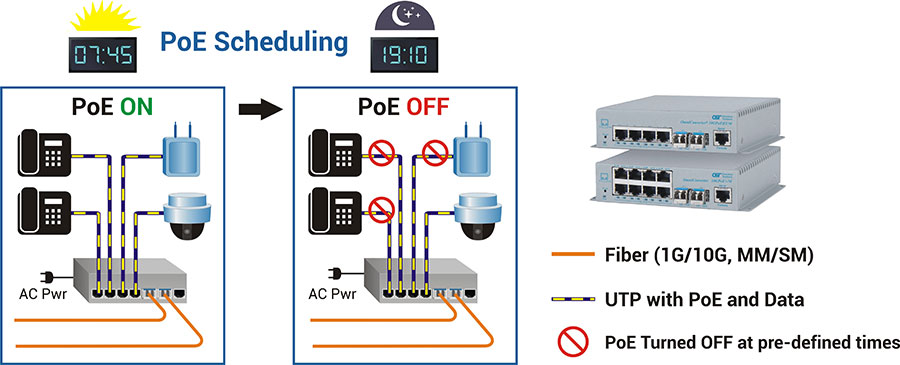
The web management allows you to automatically power on/off connected PD devices at pre-defined times of the day, which conserves energy and increases network security. For example, network managers can schedule to turn off power to their VoIP phones or WiFi Devices after business hours preventing unauthorized access and conserving energy, while having continuous PoE power to their Security Surveillance cameras 24 hours a day.