

iConverter Single-Fiber Course Wave Division Multiplexing (CWDM) modules provide a flexible and cost-effective solution for increasing the fiber capacity of single fiber networks. CWDM over single-fiber increases network bandwidth capacity by enabling multiple wavelengths, or data channels that carry independent services over existing fiber infrastructure. Up to eight separate data channels can be transported on a single fiber link with iConverter Single-Fiber CWDM modules.
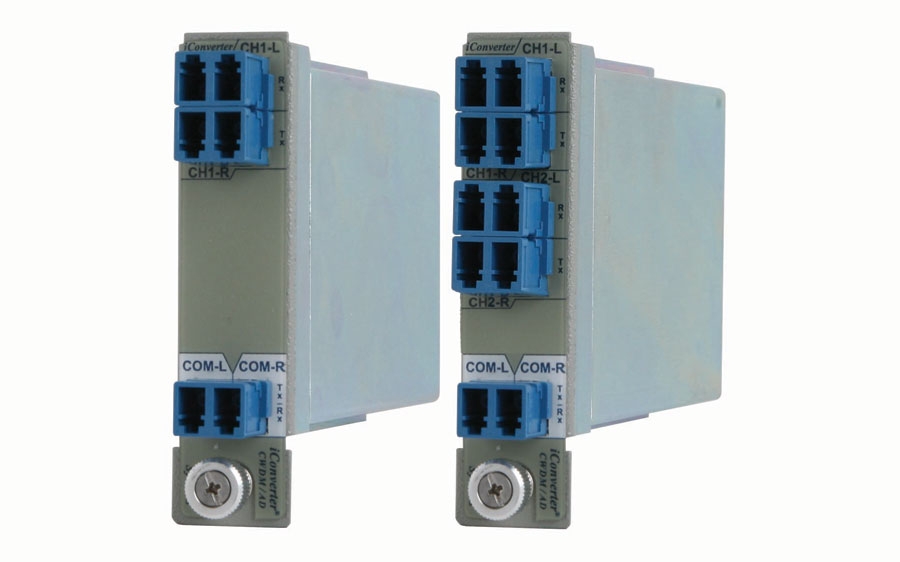
The iConverter CWDM/X and CWDM/AD single-fiber modules are protocol and rate transparent allowing different services up to 10Gbps to be transported across the same common fiber link. The single-fiber modules support dual fiber Channel Ports and single-fiber Common Port connections. Each fiber strand on the Channel Port supports a different wavelength, one wavelength for transmit (TX) and a different wavelength for receive (RX).
Single-Fiber CWDM/X Multiplexer/Demultiplexer
Single-Fiber iConverter CWDM/X modules are available in 2 and 4-Channel models, supporting a variety of wavelength combinations and port configurations. In point-to-point applications, the CWDM/X modules operate in pairs, maximizing the number of wavelengths supported.
Single-Fiber CWDM/AD Add & Drop Multiplexers
iConverter 1-Channel Single-Fiber CWDM/AD modules are CWDM Optical Add and Drop Multiplexers (OADM). The CWDM/AD modules add (multiplex) and drop (de-multiplex) one channel on one or both directions of a CWDM single-fiber link. Nine standard models of the 1-Channel Single-Fiber CWDM/AD modules are available.
iConverter CWDM/AD modules add new access points anywhere on a single-fiber CWDM network, without impacting the remaining channels traversing the network. Access points can be added to linear, bus, and ring networks, where the dual-direction ring design provides redundant protected architecture.
Features
- 2 and 4-Channel MUX/DEMUX modules
- 2 and 4-Channel modules are scalable to 4 or 8 Channels using a Band Splitter module
- 1-Channel Optical Add and Drop Multiplexers modules
- Add and Drop functions in both directions
- Protocol and rate transparent for applications up to 10Gbps
- Minimal and uniform optical loss facilitates easy network planning
- Industry standard LC connectors
- Highly compact form factor
- Seamless integration with other iConverter media converters and chassis for multi-service platforms
- Compatible with OmniLight® chassis using the iConverter LGX Adapter
- Passive device that can be installed in a powered chassis for managed applications
- One (1) Year Warranty and Free 24/7 Technical Support
Description | iConverter CWDM/X and CWDM/AD Single-Fiber CWDM MUX/DEMUX and ADD/DROP | |
|---|---|---|
| Regulatory Compliances | Safety: EMI: | UL, CE, UKCA FCC Class A |
| Environmental | RoHS, WEEE, REACH | |
Port Type | Fiber: | LC (UPC) |
| Cable Types | Fiber: | Single-mode: 9/125μm Channel Ports: Dual Fiber Common Port: Single-Fiber |
| DC Power Requirements | DC Input: (Backplane) | 3.3VDC, 0.025A @ 3.3VDC (when management is required, otherwise passive operation) |
| Dimensions W x D x H | 0.85” x 4.5” x 2.8” (21.6 mm x 114.3 mm x 71.1 mm) | |
| Weight | 12 oz. (340.2 grams) | |
Temperature | Commercial: Wide: Storage: | 0 to 50°C -40 to 60°C -40 to 80°C |
Humidity | 5% to 95% (non-condensing) | |
Altitude | -100m to 4,000m | |
| MTBF (hrs) | > 1,000,000 | |
Warranty | One (1) year warranty with 24/7/365 free Technical Support | |
Linear Add/Drop
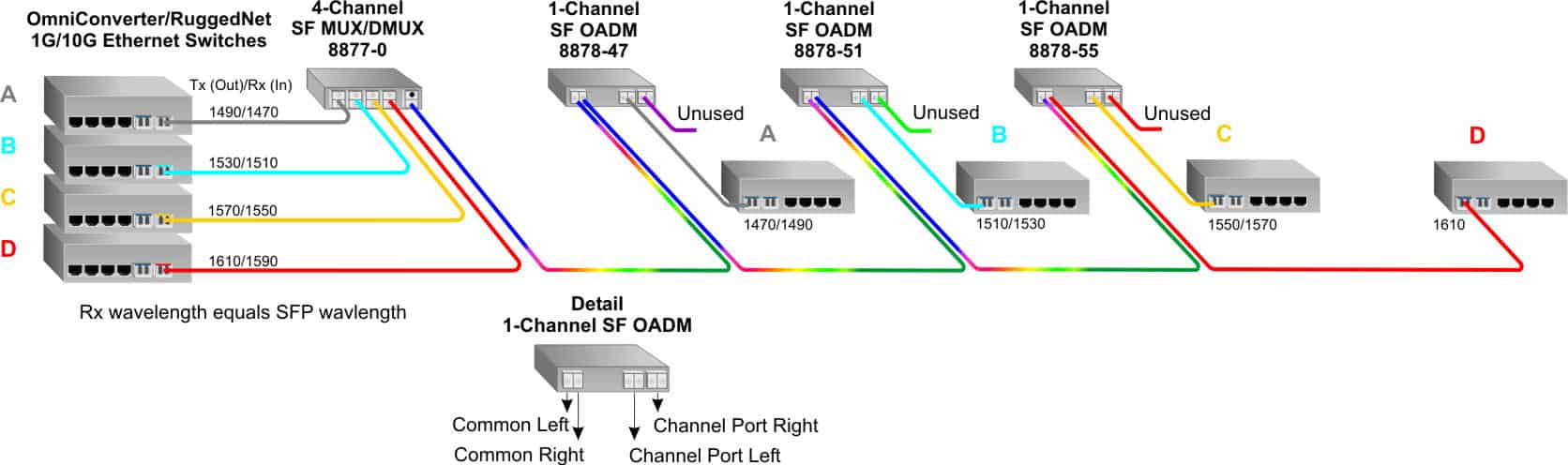
In this application, 1-Channel SF OADMs and a 4-Channel SF MUX/DEMUX module creates a linear network dropping services off to four sites on a single-fiber common link.
At the headend, a 4-Channel single-fiber MUX/DEMUX is used to connect four Ethernet switches each supporting two wavelengths over a common fiber link. At the first site, a 1-Channel OADM is installed to remove and add the 1470/1490nm wavelength which is associated with Network A. The remaining wavelengths (1510/1530nm, 1550/1570nm and 1590/1610nm) are passed through the OADM to the next site.
The 1510/1530nm wavelength associated with Network B is dropped at the second site while the 1550/1570nm and 1590/1610nm wavelengths are passed on to the last two sites. The 1550/1570nm wavelength associate with Network C is dropped at the third site. Since only 4 channels are used, the last site does not need a OADM module.
Basic Application Diagrams
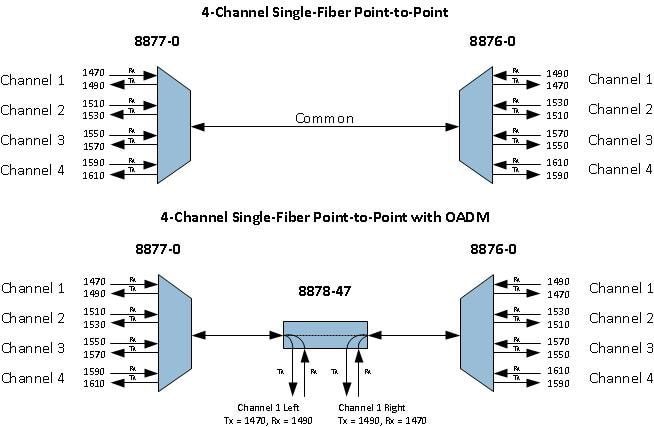
Below are block diagrams representing a 4-Channel CWDM Single-Fiber point-to-point application and a 4-Channel CWDM Single-Fiber point-to-point with an OADM somewhere in between the 4-Channel MUXs.
All Single-Fiber modules have dual fiber channel ports and single-fiber common ports. The CWDM SFP transceiver required for any single-fiber application depends on the Rx wavelength of the Single-Fiber module.
In the 4-Channel point-to-point diagram below, the CWDM SFP transceiver wavelength needed for Channel 1 of the 8877-0 module is 1470nm.
In the 4-Channel point-to-point with OADM, the CWDM SFP transceiver wavelength needed for the OADM Channel 1 Left is 1490nm and for Channel 1 Right is 1470nm.